
Blog · managing menopause at work · Menopause Policy · Menopause Support · menopause symptoms at work · women's health · workplace adjustments for menopause
How Women and Employers Can Manage Menopause Symptoms at Work
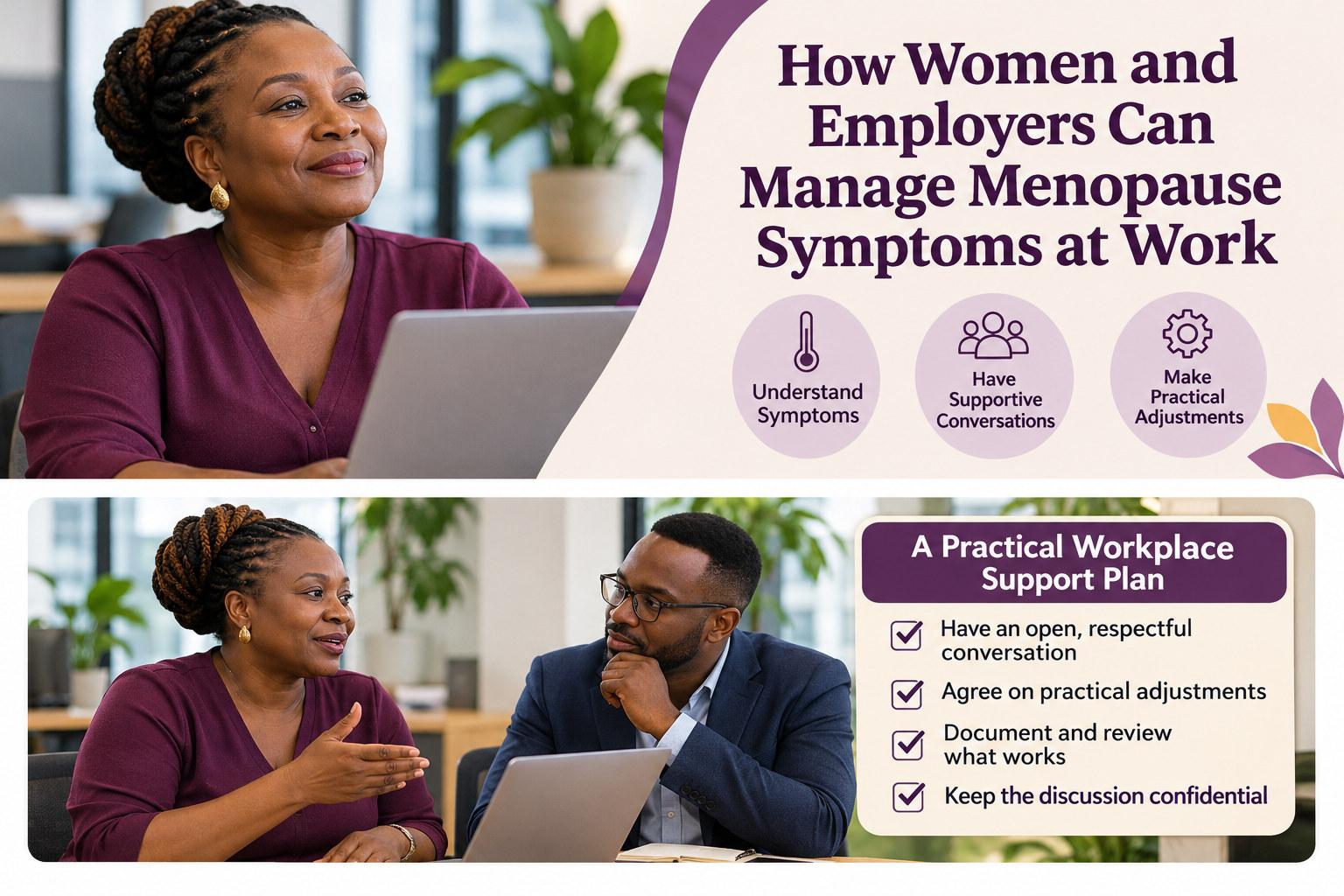
For some women, menopause symptoms are manageable alongside their usual responsibilities. For others, disrupted sleep, hot flushes or difficulty in concentrating can make an ordinary working day unexpectedly demanding. The difficulty is often not just the symptom itself, but knowing how to ask for support without feeling exposed or misunderstood.
This is where employees and employers have different but connected roles. Women need trustworthy health information and a way to explain which parts of their work have become difficult. Employers need managers who can listen, practical adjustments that reflect different jobs and clear procedures for accessing support. This guide explores both sides of that conversation, with examples relevant to workplaces across Africa.
Understanding Menopause and Perimenopause
Understanding menopause and perimenopause provides a useful starting point. Natural menopause is generally identified after 12 consecutive months without menstruation when there is no other medical explanation. Perimenopause is the transition beforehand, during which menstrual cycles and symptoms may change. Menopause is a natural life stage, not an illness, although symptoms can affect wellbeing and work. Some trans men, non-binary and intersex people may also experience menopause, so workplace support should remain inclusive.
Experiences differ. Some people have few symptoms, while others report hot flushes, night sweats, disrupted sleep, heavy or irregular periods, joint discomfort, changes in mood or difficulty concentrating. Symptoms can also have other causes. Persistent, severe or unusual symptoms warrant assessment by a qualified healthcare professional rather than an assumption that menopause is responsible.
How Can Menopause Symptoms Affect Working Life?
Concentration, Confidence and Workload
The effects can be subtle. An employee who has slept poorly may find a detailed report harder to complete, while someone experiencing a hot flush may feel uncomfortable during a presentation. These experiences do not mean that the person has become less capable. They indicate a need to understand the working conditions involved and whether a practical change would help.
Fatigue and Working Conditions
Working conditions can make those difficulties more pronounced. A hot factory floor, limited access to toilets or a rigid shift pattern may be challenging in ways that differ from office-based work. That is why useful menopause support begins with the individual employee and the realities of their role, rather than a single adjustment offered to everyone.
Research from the UK’s Chartered Institute of Personnel and Development (CIPD) documents how menopause symptoms can affect working life. Those findings are useful context but should not be presented as prevalence estimates for Africa. Similarly, Mayo Clinic researchers estimated substantial lost work time associated with menopause symptoms in the United States; the dollar estimates are US-specific, not a calculation of costs to African employers.
What Can Employees Do When Symptoms Affect Work?
Identify the Work-Related Difficulty
Before approaching a manager, it helps to distinguish the symptom from the barrier it creates at work. An employee might notice that heat makes a particular workstation uncomfortable, that an early shift is difficult after disrupted sleep or that lengthy meetings are harder to follow. Writing down when the difficulty occurs, which tasks are affected and what might help makes the request more specific. The aim is to prepare for a constructive conversation, not to prove a diagnosis.
Request Specific, Realistic Adjustments
An employee can then request a private discussion with their manager or HR contact and explain the work-related difficulty in straightforward terms: “I’ve been experiencing health-related sleep disruption. Could we try a later start time for the next few weeks and review whether it helps?” They can suggest one or two workable options, ask how the request will be handled and agree on a date to review the arrangement. If a proposed change is not feasible, it is reasonable to ask which alternatives could address the same difficulty.
Seek Appropriate Medical and Wellbeing Support
Workplace changes should sit alongside appropriate healthcare, not replace it. A qualified clinician can assess symptoms, rule out other causes and explain available treatments. Hormone therapy may be appropriate for some women, while non-hormonal treatments or other support may suit others. Digital resources and menopause apps can also help people find information or track symptoms, although they are not substitutes for medical assessment when needed.
How Can Employers Provide Meaningful Menopause Support?

When an employee raises a concern, the employer’s response can determine whether the conversation leads to meaningful support. Managers should listen without making assumptions, discuss feasible changes and agree on a time to review them. Where an employee is uncomfortable speaking with a direct manager, HR or a confidential employee assistance programme may provide another route.
Practical Adjustments to Consider
The right adjustment depends on the difficulty being addressed. Improved ventilation, drinking water, convenient toilet access and lighter uniform options may help with physical discomfort. Flexible breaks, revised start times or clearer written instructions may help in other circumstances. Remote working can be valuable for some employees, but frontline workers also need realistic options suited to their roles.
Train Managers to Respond Respectfully
For these arrangements to work consistently, managers need more than general awareness. They should know how to ask about work-related needs, protect personal information, agree on reasonable next steps and involve HR or occupational health when appropriate. Their role is to support the employee at work, not to diagnose symptoms or recommend treatment.
Balance Awareness With Privacy
Awareness and privacy are equally important. Organisation-wide training can address misconceptions and explain what support exists, while individual conversations remain confidential. Employees should not be singled out because of their age or gender, or expected to discuss symptoms publicly. A supportive culture makes help available without making disclosure a condition of belonging.
Workplace Adjustments at a Glance
The following examples are options to discuss, not guaranteed solutions. Any adjustment should be assessed against the employee’s circumstances, the role and relevant local requirements.
| Workplace challenge | Possible effect | Adjustment to discuss |
| Hot flushes or discomfort | Difficulty working in heat | Ventilation, water, uniform options |
| Disrupted sleep or fatigue | Difficulty with early shifts | Flexible starts, breaks where feasible |
| Concentration difficulties | Complex tasks take longer | Written instructions, clear priorities |
| Heavy or irregular bleeding | Need for frequent toilet access | Reliable facilities, flexible breaks |
What Should a Workplace Menopause Policy Include?
Individual support becomes easier to provide when the organisation has a clear process. Whether menopause is addressed in a dedicated policy or within existing wellbeing guidance, employees should know whom to contact, how adjustments are considered and when arrangements will be reviewed. A useful policy therefore connects awareness with everyday decisions, rather than remaining a document that staff rarely consult.
Essential Elements of a Menopause Policy
Purpose and scope: explain who the policy supports and how it connects with existing wellbeing, leave, safety and inclusion policies.
Confidential contact and requests: identify who employees can approach and how to request support without unnecessary disclosure.
Possible adjustments: describe examples while making clear that arrangements will be considered individually.
Manager responsibilities: set expectations for respectful conversations, privacy, referrals and follow-up.
Leave and medical appointments: clarify how existing leave and flexibility arrangements apply, without promising rights that local law or contracts do not provide.
Review and accountability: assign responsibility for reviewing the policy, training managers and checking whether adjustments remain useful.
For employers developing a fuller policy, MAWA’s article on creating a menopause-friendly workplace in Africa provides additional context. The checklist above is an editorial guide, not a jurisdiction-specific legal template.
Employment Rights and Support Routes Across Africa
The legal context also matters, particularly for organisations operating in more than one African country. Employment protections, leave arrangements and complaint procedures vary by jurisdiction and contract. Employers should check the requirements that apply locally rather than assume guidance from another country creates the same rights for their workforce.
In Nigeria, menopause-specific statutory entitlements should not be assumed. Employment disputes can involve constitutional, statutory, contractual and judicial considerations that depend on the facts. It would be misleading to promise that a particular discrimination claim or remedy automatically applies to menopause-related symptoms. This section provides general information, not legal advice.
How Should Employees and Employers Follow Up?
For Employees
Employees may find it helpful to keep a short record of agreed adjustments, review dates and any concerns that remain unresolved. If an initial request is declined, they can ask for the reason, explore alternatives and, where available, consult HR, an employee representative or the organisation’s formal grievance process. The appropriate route depends on local law and workplace procedures; seeking guidance does not require an employee to make assumptions about their legal entitlements.
For Employers
For employers, the priority is to make the process dependable: identify a confidential contact, explain how requests are assessed, offer adjustments suited to different job roles and agree on a review date. A manager should explain why an option is impractical rather than simply dismissing the concern, and consider alternatives where possible. Smaller businesses may start with a simple written process, while larger organisations may connect staff to occupational health or an employee assistance programme.
Frequently Asked Questions
Does every employee experience menopause in the same way?
No. Symptoms, severity and the effect on work vary. Support should be individual rather than based on assumptions.
Must an employee disclose menopause to request an adjustment?
Not necessarily. An employee can often begin by describing a work-related difficulty and the support they need. Specific disclosure requirements depend on the request, employer process and applicable law.
Is hormone therapy the only treatment?
No. Treatment options vary, and a qualified healthcare professional can help assess which approaches are appropriate.
Should employers create a separate menopause policy?
Not always. Some organisations integrate menopause support into existing health, wellbeing and flexible-working policies. What matters is that responsibilities, support routes and adjustments are clear.
Can small businesses address menopause without a large budget?
Yes. Clear conversations, reliable break arrangements, practical environmental changes and basic manager guidance can be useful starting points.
Conclusion
A supportive response to menopause begins with a practical question: what would make this employee’s working day more manageable? Women should be able to raise concerns, explore suitable adjustments and seek medical advice without having to justify every symptom. Employers, in turn, should respond consistently, protect confidentiality and review whether agreed changes are working. When both sides understand their roles, menopause support becomes part of everyday workplace practice rather than an isolated awareness activity.