
Blog · Corporate Menopause Support · Employee Wellbeing · Global HR · Menopause Education · Menopause Webinars · Multinational Organisations · Workplace Menopause · Workplace Wellbeing
Menopause Webinar Providers for Multinational Organisations
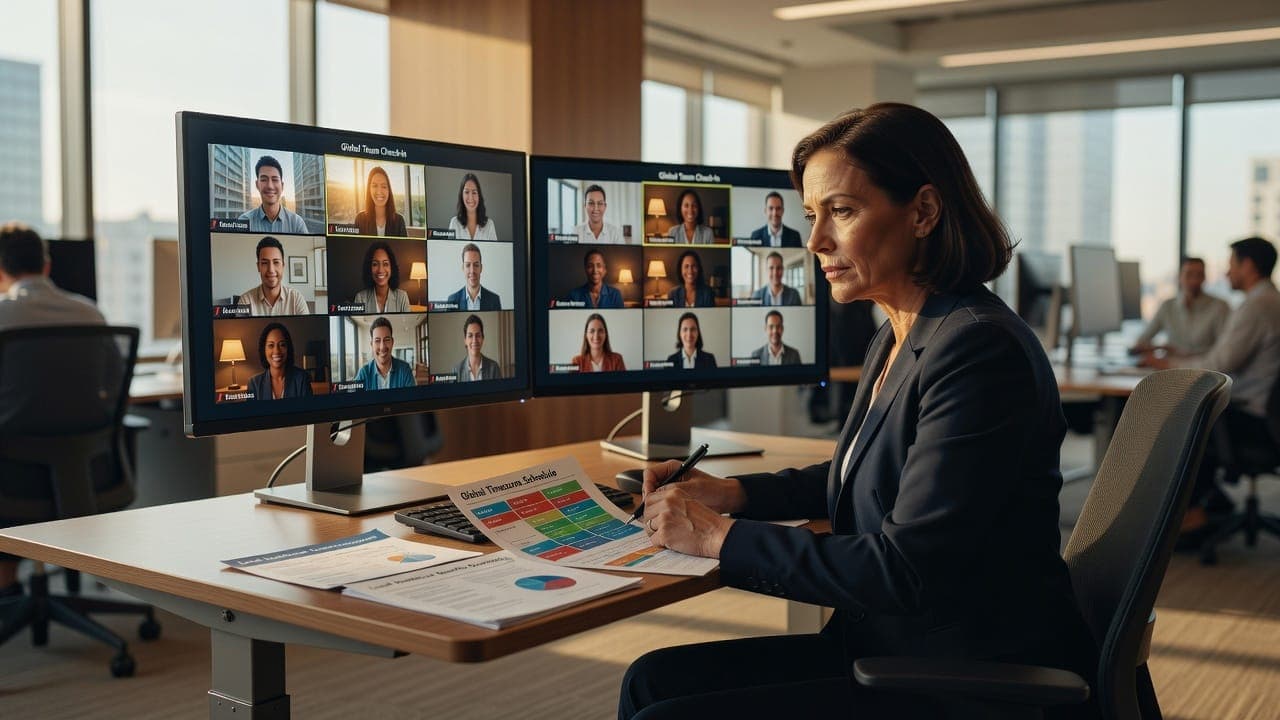
Picture this. Your HR director in London is rolling out a menopause support initiative, and it lands beautifully with the team in the Manchester office. Then someone in the Lagos branch asks why the webinar started at 2am their time, and someone in Singapore wants to know why every case study features a woman named “Sarah” from Surrey. This is the exact headache that trips up most multinational organisations trying to get menopause education right. The honest answer to “which menopause webinar provider should we pick” isn’t a single brand name. It’s a provider that treats time zones, culture, and clinical rigour as three equally weighted problems, not an afterthought bolted onto a PowerPoint deck.
Menopause, for anyone still fuzzy on the boundaries, isn’t a single event. It’s a transition, often preceded by years of perimenopause, marked by fluctuating oestrogen and progesterone that mess with sleep, mood, concentration, and yes, career trajectory. It is not “just hot flashes,” and it is not something that only affects women in their fifties sitting in head office. For a distributed workforce spanning EMEA, APAC, and the Americas, that biological reality collides with wildly different cultural attitudes toward discussing it out loud. That collision is precisely why picking the right webinar partner matters so much more than it would for a single-site company.
What Makes a Menopause Webinar Provider Right for Global Teams?
A provider built for one office in one city can get away with a live Zoom session at 10am and calling it done. A provider serving a distributed workforce cannot. I’ve seen HR leaders assume that “global” simply means translating slides into three extra languages, but that’s surface-level thinking. The real test is whether the program still feels relevant, useful, and non-awkward whether you’re logging in from a coworking space in Nairobi or a home office in Toronto during a snowstorm.
Asynchronous and multi-timezone access
Live-only formats quietly punish entire regions. If your webinar airs at 9am GMT, that’s already midnight in parts of APAC and stupidly early in the Americas. Third-party workplace reviewers keep circling back to this point: a genuinely global program needs robust, on-demand libraries sitting alongside the live sessions, not as a consolation prize but as an equally valid front door. Employees in different BST or GMT offsets shouldn’t feel like second-class participants because their region got the “watch later” link while headquarters got the real experience.
Cultural nuance and regional localization
Menopause symptoms don’t discriminate by geography, but the conversation around them absolutely does. Age of onset varies by ethnicity and region, healthcare access varies even more, and the stigma attached to discussing hot flashes in a client meeting in Tokyo is not the stigma attached to the same conversation in Amsterdam. Peer-reviewed research on workplace-based interventions has found that education tailored to context, rather than generic scripts, drives measurably better organisational attitudes and confidence among staff. A provider worth paying for builds region-specific case studies rather than recycling one Western template across every office.
Clinical accuracy and CPD accreditation
Here’s where I get a bit particular. Plenty of wellness vendors will happily bolt “menopause” onto a general women’s health webinar without a shred of clinical oversight. That’s a problem, because bad information about hormone therapy or symptom management spreads fast and does real damage. Look for providers whose content is either delivered by, or reviewed by, accredited menopause specialists, and where CPD accreditation exists for the HR leaders and managers sitting through the training. Frameworks aligned with recognised standards give multinational firms something concrete to point to during an audit, rather than a vague promise that “the content is evidence based.”
Why Should Multinational Organizations Invest in Menopause Education?
The business case here isn’t soft. The CIPD’s own workplace research found that two-thirds of women experience mostly negative effects at work due to menopause symptoms, and roughly one in six have seriously considered leaving their job because support simply wasn’t there. That’s not a minor HR footnote. That’s a retention crisis hiding in plain sight, quietly draining institutional knowledge out the door.
Retention of experienced women leaders
Women going through menopause are frequently in their peak leadership years, the ones who’ve spent fifteen or twenty years building expertise your organisation cannot easily replace. Losing them to poor symptom management or a workplace that made them feel dismissed is an expensive, avoidable mistake. The AARP’s economic impact brief puts a number on this that tends to make finance teams sit up, estimating billions in lost productivity tied directly to inadequate employer support.
Reduced stigma across diverse offices
Stigma compounds when nobody’s talking. One office assumes another office simply “doesn’t have this problem,” when really nobody there feels safe raising it. Rolling out consistent, well-facilitated menopause webinars across every regional office signals, structurally, that this is a normal health conversation and not a taboo one. That consistency matters more in distributed teams than centralised ones, because there’s no water-cooler cross-pollination to naturally spread awareness between locations.
Stronger employer brand and compliance posture
There’s also a straightforward compliance angle multinational HR leaders can’t ignore. The British Standards Institution’s BS 30416, described in its official standard announcement, became the world’s first national workplace standard addressing menstrual and menopausal health, giving employers a benchmark framework to build policy against. Meanwhile, guidance from bodies like Acas makes clear that documenting reasonable adjustments isn’t optional goodwill, it’s fast becoming an expectation woven into broader disability and equality frameworks in several jurisdictions.
Employee Tracks vs Manager Tracks: Which Do You Need?
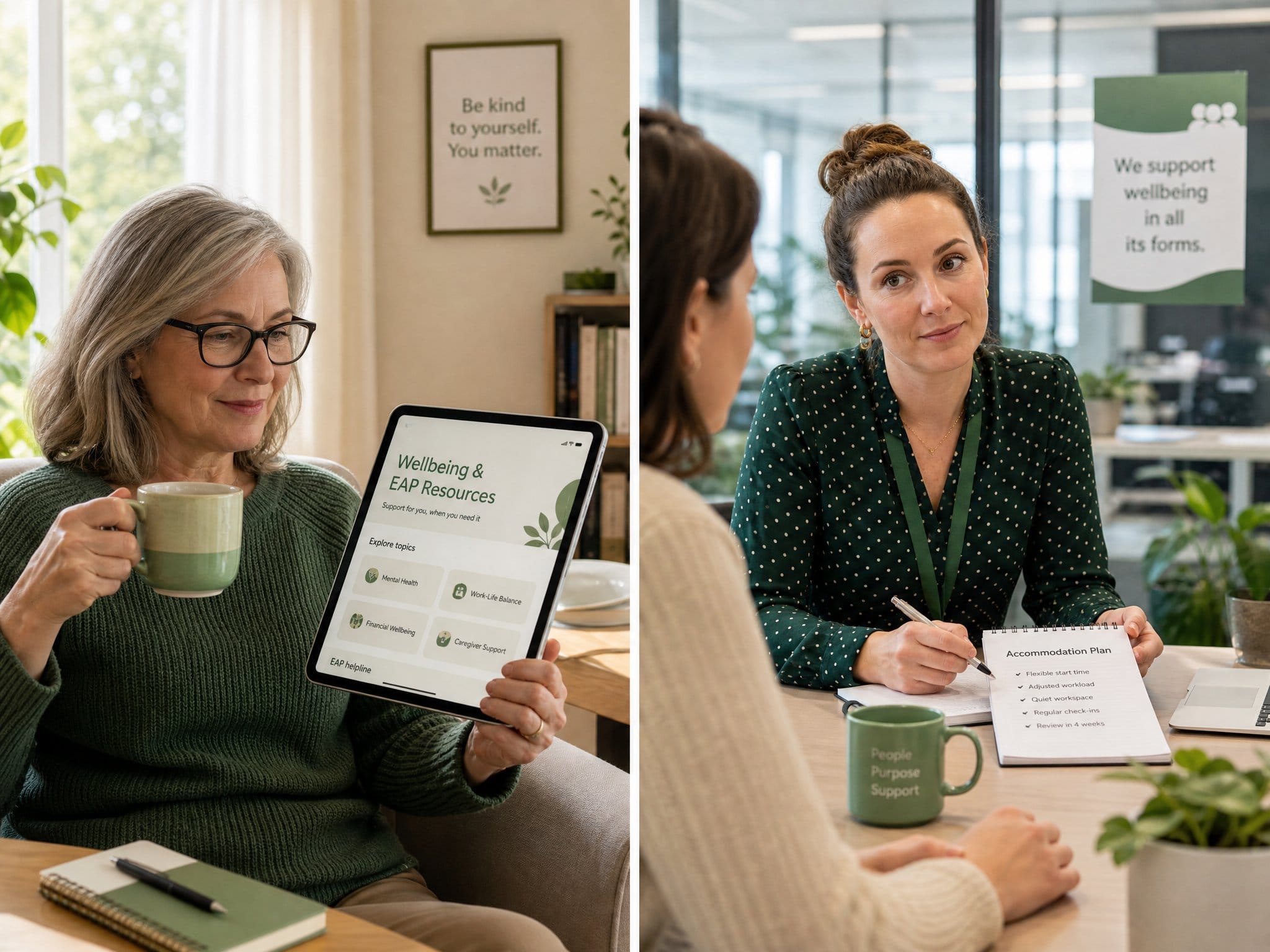
Both, honestly. Trying to run one generic session for everyone, executives and frontline staff alike, tends to satisfy nobody. The content that reassures an employee experiencing brain fog is not the content a manager needs to learn how to hold an accommodations conversation without fumbling it.
General employee awareness sessions cover symptom recognition, normalising the transition, and pointing staff toward internal resources like EAPs or symptom checkers, without turning into a medical consultation.
Manager empathy and accommodation training focuses on how to respond when someone discloses symptoms, how flexible or hybrid working arrangements might help, and how to avoid the well-meaning but clumsy comments that do more harm than silence.
HR and leadership compliance briefings dig into legal obligations, policy documentation, and how the organisation’s menopause policy interacts with existing disability and equality frameworks across each jurisdiction it operates in.
Menopause Friendly’s own research on manager confidence backs this tiered approach up, noting that targeted training measurably builds the confidence line managers need to have these conversations without defaulting to awkward avoidance.
How Do Providers Handle Language and Cultural Barriers?
This is where a lot of otherwise decent providers quietly fall short, and it’s worth pressing them on directly during a sales call rather than assuming it’s covered.
Subtitled and translated webinar content
Live translation is expensive and often clunky. Subtitled, professionally translated recordings tend to work better for distributed teams, letting someone in São Paulo or Seoul absorb the same core content without relying on a rushed simultaneous interpreter. Ask providers directly how many languages their library actually supports, not just their marketing homepage.
Region-specific case studies and examples
A case study about navigating a UK GP referral means very little to an employee in a country with a completely different healthcare access model. Providers with genuine global reach build out separate examples for different healthcare frameworks, which is a small detail that signals a much deeper level of preparation.
Local healthcare framework alignment
Guidance from the European Menopause and Andropause Society’s global recommendations explicitly calls out that cross-border employers carry responsibility for aligning workplace support with the realities of local healthcare systems, rather than assuming one national model applies everywhere.
How Should You Roll Out a Menopause Webinar Program?
Rolling this out badly is almost worse than not rolling it out at all, because a poorly promoted, half-attended webinar just becomes ammunition for skeptics who say “see, nobody cares.” Getting the sequencing right matters.
Pre-launch communication needs genuine leadership buy-in, ideally with a senior executive, and not just someone from HR, publicly backing the initiative before the first invite even goes out. Scheduling across regions demands honest math rather than wishful thinking; running two or three live sessions staggered across GMT, EST, and a APAC-friendly slot, then backing all three with the same on-demand recording, tends to work far better than one heroic 6am call that half your workforce quietly skips. Post-webinar, the real value shows up in what happens after the screen goes dark: a resource hub, a follow-up email with the recording, maybe access to qualified therapists or an EAP hotline, so the momentum doesn’t just evaporate the next morning.
How Do You Measure the Success of a Menopause Webinar?
Attendance numbers alone tell you almost nothing useful. A far better read is a short post-webinar survey gauging whether employees feel more comfortable discussing symptoms with a manager, whether managers feel more confident having that conversation, and whether people actually know where the internal support resources live. Pair that with a look at whether requests for flexible working or reasonable adjustments tick upward afterward, since research summarised in a ScienceDirect analysis of workplace interventions found that scalable digital education correlates with measurable drops in symptom-related performance disruption. That’s the kind of outcome finance teams actually respect.
What Should Be in Your Provider Evaluation Checklist?
Criteria | Why it matters for distributed teams |
|---|---|
On-demand library depth | Covers every time zone without penalising any region |
Clinical/CPD accreditation | Protects against outdated or inaccurate medical advice |
Localized case studies | Keeps content relevant beyond one country’s healthcare model |
Manager-specific modules | Builds accommodation confidence, not just awareness |
Translated/subtitled content | Removes language as a participation barrier |
Post-webinar resource access | Sustains engagement beyond the live event |
How Does Menopause Support Fit Into Broader Wellbeing Benefits?
Menopause education shouldn’t sit as an orphaned initiative floating apart from your broader family benefits strategy. It fits far more naturally alongside parental leave, fertility support, and general mental health resources, all under one coherent wellbeing umbrella. Digital health platforms that combine live education with ongoing individualised clinical access, the kind of hybrid model described in Maven Clinic’s own on-demand webinar on menopause benefits, tend to bridge that gap between a one-off learning event and genuine continuous care. For HR leaders building out priorities for the upcoming year, menopause belongs in the same conversation as any other life-stage health issue affecting long-term retention.
FAQ
Is a single global webinar enough for a multinational company? No. One session, however well produced, cannot account for time zone fairness or cultural relevance across regions, which is exactly why on-demand libraries and localized content matter so much.
Should managers attend the same session as employees? Generally, no. Separate tracks work better since managers need accommodation and conversation skills, while general staff need symptom awareness and internal resource pointers.
Does menopause support count as a legal obligation, or is it purely goodwill? Increasingly, it’s treated as connected to existing disability and equality obligations in several jurisdictions, based on recent guidance from bodies like the Equality and Human Rights Commission, so treating it purely as optional goodwill is a shortsighted read of where policy is heading.
Conclusion
Choosing a menopause webinar provider for a distributed workforce isn’t really about finding the flashiest deck or the biggest brand name. It’s about whether the program respects time zones, respects cultural difference, and rests on genuine clinical authority rather than wellness-industry fluff. Get those three things right, and the ripple effects show up exactly where HR leaders and finance teams both care most: retention, reduced stigma, and a workplace culture that doesn’t quietly lose its most experienced people to silence.