Blog · Manager Training · Menopause at Work · Menopause Manager Training · Menopause Policy · Menopause Support · Workplace Menopause Support · Workplace Wellbeing
Manager Training to Support Employees Experiencing Menopause: A Practical Guide
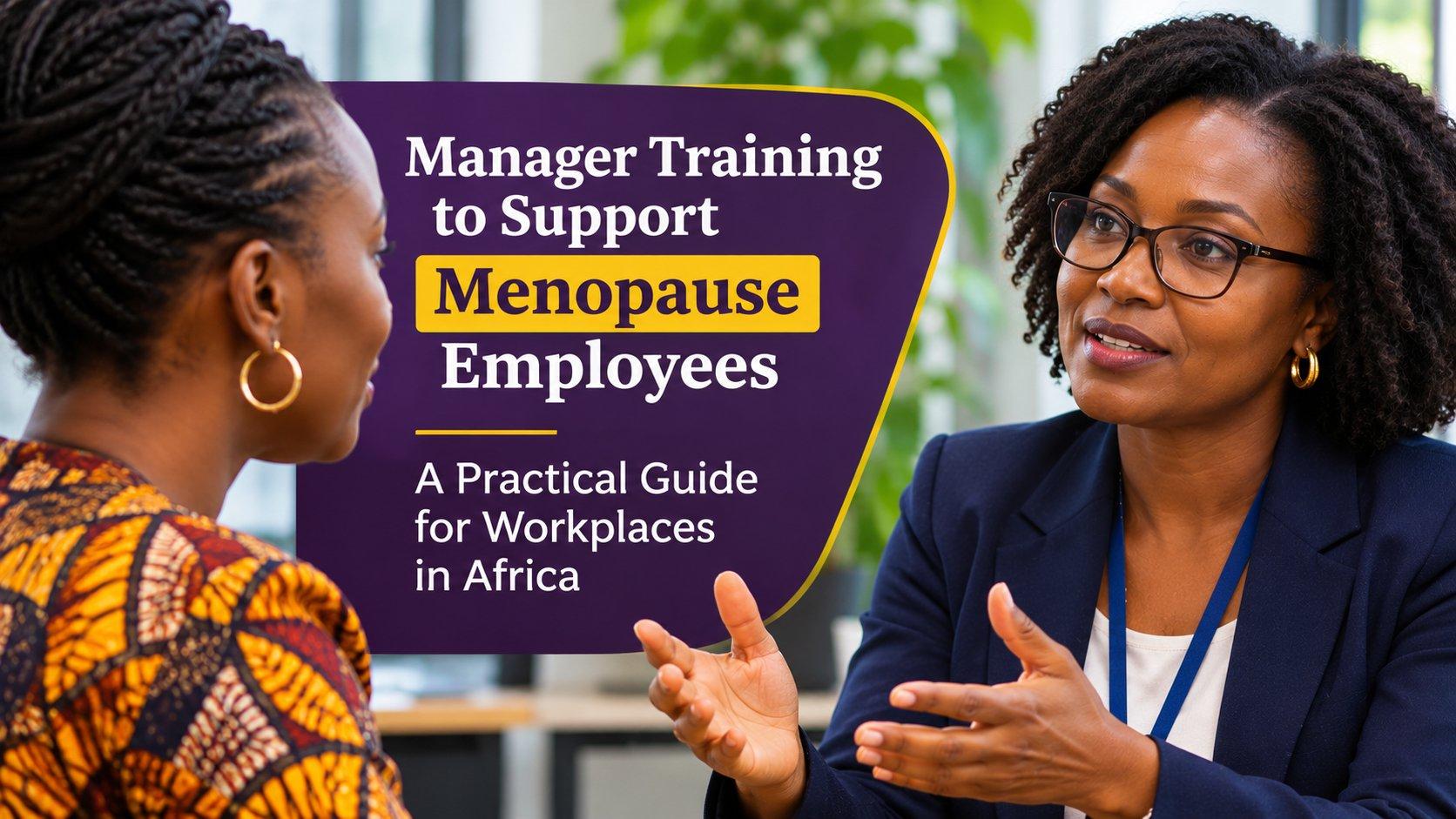
A workplace may have a menopause policy and still leave employees uncertain about where to seek support. Whether employees feel supported often depends on how managers respond when someone mentions disrupted sleep, difficulty concentrating or working conditions that make symptoms harder to manage. A respectful conversation can lead to a practical adjustment; an awkward or dismissive response may discourage the employee from raising the issue again.
Manager training helps close that gap. It gives supervisors enough knowledge to respond without making assumptions, a clear understanding of the adjustments they can explore and guidance on when to involve HR or a healthcare professional. For organisations across Africa, the approach should be adaptable to different workplace sizes, shift patterns, resources and legal requirements.
This guide explains what training should cover, how managers can put it into practice and how employers can assess whether the programme is improving everyday experiences.
Why Does Menopause Training Matter for Managers?
Menopause experiences vary widely. Some employees have few symptoms, while others experience hot flushes, disrupted sleep, fatigue, anxiety or changes in concentration. The same symptom may be manageable in one role but more disruptive in another: heat discomfort can be harder to cope with in a poorly ventilated workspace, while disrupted sleep may make an early shift particularly demanding.
These examples do not mean that a manager can identify menopause from someone’s behaviour. They show why training should focus on understanding possible workplace barriers and inviting employees to discuss support without requiring a medical explanation.
Without training, a manager may respond to a missed deadline or repeated lateness solely through the usual performance process. Performance expectations still matter, but managers should explore relevant workplace barriers before deciding how to respond. Training helps them maintain fair standards while considering reasonable support requests. The distinction matters: managers can discuss the demands of a role and possible adjustments, while diagnosis and treatment remain matters for qualified healthcare professionals.
Why a written policy is not enough
A policy establishes expectations, but employees experience those expectations through their interactions with supervisors. If a manager does not know what to say, what can be adjusted or how to protect confidentiality, the policy may offer little reassurance. Training should therefore show managers how to apply the policy when an employee requests an adjustment, including which options they can approve and when HR advice is needed. MAWA’s guide to supporting employees at work outlines the broader responsibilities that training should reinforce.
What Benefits Can Organisations Expect?
The first benefit is greater consistency across teams. Without shared guidance, one supervisor might agree to a temporary change in start time while another rejects a similar request because they are unsure what is permitted. Training gives managers common principles for considering requests, documenting decisions and knowing when to seek HR advice. Employees can then approach a discussion with a clearer sense of what to expect. Because roles have different operational demands, the adjustment offered may vary, but the reasoning behind each decision should remain fair, respectful and clear.
Timely workplace adjustments may help experienced employees continue contributing in their roles, while respectful responses can strengthen their confidence in management. CIPD’s research on menopause at work and The Menopause Society’s employer guidance highlight the importance of support, although their findings largely reflect settings outside Africa. Employers should therefore examine their own workforce needs rather than assume those findings predict a particular reduction in absence or turnover. To make these benefits possible, training must reach the people who make everyday decisions about work.
Who Should Receive Menopause Awareness Training?
Start with anyone responsible for supervising employees: line managers, team leaders, shift supervisors and departmental heads. HR professionals should receive more detailed instruction on policies, escalation routes and confidential recordkeeping. Senior leaders also need enough understanding to allocate resources and reinforce expectations.
Broader awareness sessions can help colleagues understand why respectful language matters. However, general awareness is not a substitute for practical manager training. The people approving schedules, reviewing performance and handling workplace concerns need opportunities to practise decisions they may actually face. The MAWA menopause manager training framework offers a useful starting point for defining those skills.
What Should Manager Training Cover?
1. Understanding menopause without diagnosing employees
Training should explain that perimenopause is the transition leading up to menopause, during which menstrual patterns and symptoms may change, and that menopause is usually recognised after 12 consecutive months without a period when no other cause explains the absence. These basics help supervisors understand why an employee’s needs may fluctuate over time without expecting them to provide medical advice. For instance, a colleague may manage well for several weeks and then find a particular shift or work setting more difficult. Managers should avoid treating that variation as inconsistency or assuming every midlife employee has the same experience. Workplace support should be based on the difficulties the employee identifies, not on a presumed diagnosis.
2. Identifying practical workplace adjustments
Training should connect common work-related difficulties with realistic responses. Someone experiencing heat discomfort may benefit from improved ventilation, access to drinking water or flexibility around uniforms. An employee struggling after disrupted sleep may wish to discuss a different start time, scheduled breaks or a temporary adjustment to meeting arrangements. In shift-based or customer-facing roles, the options may be narrower, but managers can still explore changes to break schedules, task allocation or access to facilities.
The adjustment discussion should also address practical constraints. A supervisor may be able to rearrange break times immediately but need HR approval to change a contractual schedule or purchase equipment. Training should give managers a simple decision path: understand the difficulty, consider available options, check whether approval is required and agree when the arrangement will be reviewed. If an employee requests a change that cannot be accommodated as proposed, the conversation should continue towards an alternative rather than end with an unexplained refusal. A review date matters because an adjustment that works during one period may need to change as symptoms or job demands change.
3. Respectful conversations and confidentiality
Managers should practise opening a conversation without mentioning menopause unless the employee chooses to. A neutral question such as, ‘I’ve noticed this schedule has been difficult recently. Is there anything about the working arrangements we should discuss?’ focuses on support rather than presumed medical causes. If an employee discloses symptoms, the manager can ask which aspects of work are difficult and what changes might help.
Training must also cover what information can be recorded, who may access it and when consent or another lawful basis is needed. Medical details should not circulate through team chats or informal conversations. Employers operating in different African countries should review their own data protection and employment obligations rather than rely solely on UK guidance.
4. Knowing when to refer a concern
Referral routes should be specific enough for managers to use without improvising. HR may need to advise when a proposed adjustment affects contractual arrangements or when a concern overlaps with a formal performance process. Occupational health, where available, may advise on functional work needs. A healthcare professional is the appropriate person to assess symptoms and treatment options. Training should explain what the manager can say when referring someone, what information may be shared and what happens next. Otherwise, ‘speak to HR’ can become a way of ending a conversation without ensuring that support continues.
How Can Managers Hold Supportive Conversations?
A supportive conversation begins before the meeting itself. Choose a private setting, allow enough time and be clear about the work-related concern you want to discuss. Rather than suggesting a medical explanation, describe what you have noticed and invite the employee’s perspective. For example, a manager might ask whether the current schedule or work environment is creating difficulties and whether any changes would help. This allows the employee to decide how much personal information to share.
If an employee raises a symptom or health concern, acknowledge it without attempting to diagnose or immediately offering a solution. Ask which tasks or conditions are most difficult and discuss the options within your authority. Where an adjustment needs approval, explain who will be involved and what information must be shared. Before ending the meeting, agree on one or two practical steps, identify who will take them and arrange a review date. Record only what is needed to implement the agreement under the organisation’s privacy procedures. MAWA’s guidance on menopause disclosures at work provides further context for handling sensitive discussions.
How Should Employers Roll Out the Training?
Managers are more likely to use these skills when the organisation provides a clear process behind them. Before scheduling workshops, review existing policies, responsibilities and employee feedback to identify the situations that create uncertainty. A factory supervisor may need guidance on breaks and temperature control, while a remote team leader may need to discuss flexible hours and meeting schedules. Training should reflect these differences rather than assume every employee works in an office. Smaller employers can also draw on MAWA’s guide to menopause support without formal policies when deciding what is feasible.
Stage 1: Prepare the guidance
Give one HR professional or senior leader responsibility for the programme. Before training begins, clarify which adjustments supervisors can approve, when they must consult HR and how employees can request support. Check that examples reflect local employment and privacy requirements, and prepare a short guide managers can use after the session. These decisions prevent managers from learning a process that the organisation cannot actually deliver.
Stage 2: Deliver interactive sessions
Begin with concise information about menopause and the limits of a manager’s role, then devote substantial time to realistic scenarios. Participants can practise opening a neutral conversation, responding when an employee declines to disclose medical details and considering adjustments within a limited budget. Facilitators should explain why certain responses are more respectful or workable than others. Schedule sessions during paid working hours where possible, with accessible alternatives for remote staff and shift workers.
Stage 3: Reinforce and review
After the workshop, managers need somewhere to turn when a real situation arises. Provide a concise reference guide, a named HR contact and a straightforward route for approving or reviewing adjustments. Include the guidance in manager onboarding and revisit it when policies change or feedback identifies recurring problems. As new managers join and working arrangements change, the same guidance remains available rather than depending on memories of a single workshop.
How Can You Measure Whether Training Works?
Training is only useful if managers can apply it, so evaluation should examine behaviour as well as attendance. Before the first session, ask managers how confident they feel discussing sensitive workplace needs and ask employees, anonymously where practical, whether they understand how to request support. Repeat these questions after training and at suitable intervals to see whether confidence is matched by clearer processes and better experiences.
Completion rates show whether managers attended, not whether they can apply what they learned. A stronger evaluation combines short knowledge or scenario checks with evidence that agreed adjustments are followed through. Employers can ask managers what they would do if an employee requests flexibility without disclosing a diagnosis, then review whether the answer reflects policy and confidentiality expectations. Employee feedback adds another perspective: people may know a policy exists but still feel unsure about approaching their supervisor. Absence and retention trends can provide context over time, although changes in staffing, workload and wider conditions make them unreliable as stand-alone proof of training impact.
Suggested monitoring framework
| Measure | How to assess | Review timing |
| Manager confidence | Anonymous preparedness survey | Before, after and at follow-up |
| Adjustment follow-through | Aggregate HR review of agreed changes | Periodic review |
| Employee trust | Anonymous survey on awareness and privacy | Baseline and follow-up |
| Programme reach | Participation by team, shift and location | After each training cycle |
These indicators are suggested measures rather than fixed targets. An increase in support requests may reflect greater trust, while absence and retention trends can change for unrelated reasons. Report results in aggregate and avoid identifying employees in small groups.
The measures above are suggested indicators, not fixed performance targets. An increase in requests for support may indicate that employees trust the process more, while changes in absence or retention may have several causes. Because evaluation can involve sensitive information, organisations should use aggregated results and avoid reporting small groups in ways that could identify individuals.
How Should Employers Protect Health Information?
An employee may be comfortable telling a manager that symptoms are affecting their work but not want colleagues to know the details. Training should show supervisors how to respect that boundary while still implementing an adjustment. For example, a rota change can usually be communicated as a scheduling decision without explaining an employee’s health circumstances to the whole team. Managers should record only the information necessary to arrange support, store it in approved systems and restrict access to those who genuinely need it. HR should explain how records are used, how long they are kept and what process employees can follow if they have privacy concerns.
Privacy requirements vary across African jurisdictions. Organisations should check the laws that apply to their employees and operations, including rules governing sensitive personal information. The principle is consistent even when the legal details differ: protect the employee’s dignity and avoid unnecessary disclosure.
Frequently Asked Questions
Do managers need medical qualifications to support menopause at work?
No. Managers need enough awareness to respond appropriately to work-related concerns, not to assess symptoms or recommend treatment. Training should give them practical examples of when HR or a healthcare professional should become involved.
Can a small business provide useful training without a large HR department?
Yes. A small employer can begin with a short training session, written guidance on conversations and a clear decision-maker for adjustments. The important point is that employees know whom to approach and that managers can follow through on what they agree.
Should employees be required to disclose menopause symptoms?
No. Employees should be able to discuss the effects of working conditions without being pressured to disclose a diagnosis. A manager can ask which tasks or arrangements are difficult and explore possible changes, while following applicable procedures where formal documentation is genuinely required.
How often should training be refreshed?
Review the programme when policies change, new managers join or employee feedback reveals uncertainty. Rather than repeating the same presentation, use refreshers to address actual questions and scenarios that have emerged since the previous session.
Conclusion
Manager training becomes meaningful when an employee can raise a workplace difficulty and receive a respectful, practical response. That requires more than awareness of menopause symptoms. Supervisors need clear authority to consider adjustments, confidence in sensitive conversations and a reliable route to HR or specialist advice when necessary.
A manageable first step is to review one existing workplace policy or process, identify the decisions managers currently find difficult and build training around those situations. From there, employers can test the approach, listen to employee feedback and improve it over time. The aim is consistent support that employees can actually use, whatever the size or location of the organisation.