
Blog · employee menopause support · menopause awareness training · Menopause Manager Training · menopause training for HR · menopause training workshops · menopause workplace support · virtual menopause training
In-Person vs Virtual Menopause Training Workshops: An HR Guide
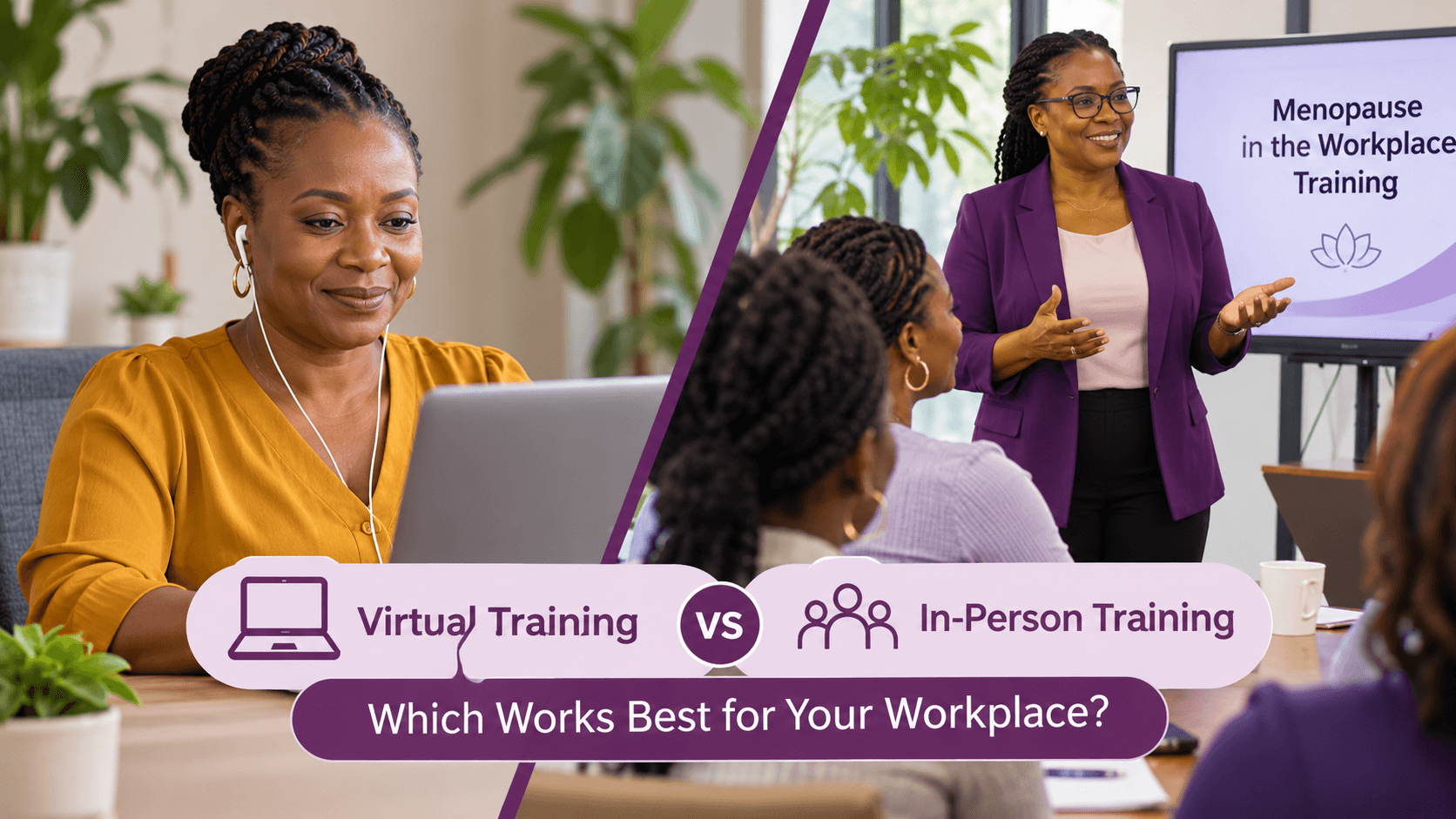
Choosing between in-person and virtual menopause training involves more than deciding where a workshop will take place. HR teams need to consider whether employees can attend, whether they will feel comfortable participating and whether the session will help them respond appropriately at work. These considerations are closely connected. A workshop may provide useful information, but its impact will be limited if the people who need it cannot take part or have no opportunity to apply what they learn.
For employers across Africa, the choice is further shaped by the circumstances in which people work. Teams may be spread across several cities or countries, follow different shift patterns or have unequal access to reliable internet and private spaces. These differences influence how employees experience training. Someone joining online from a shared office may hesitate to ask a question, while a shift worker may be unable to attend a session scheduled for the middle of the working day. A format that appears convenient or inexpensive on paper may therefore be less useful in practice.
The right format depends on what the training is intended to achieve. An online session may be suitable for introducing a large workforce to menopause awareness and available support. Managers, however, may need a more interactive setting in which they can discuss difficult situations, practice responding to requests and receive feedback. HR should therefore begin by identifying the learning objectives and the needs of each audience, rather than assuming one format will suit everyone.
Why Does the Training Format Matter?
Menopause can affect people’s working lives in different ways, particularly when symptoms interact with the demands of their roles. In a 2023 survey of more than 2,000 employed women aged 40 to 60 in the UK, the CIPD found that 73% reported menopause-transition symptoms. Among those who had experienced symptoms, 67% said they had a mostly negative effect at work. Although these findings come from the UK and cannot be used to estimate experiences across African workforces, they help explain why employers need to consider how menopause symptoms may affect employees at work.
Training can help employers move from recognising menopause as a workplace issue to responding more appropriately. For employees, this may mean understanding how everyday comments and assumptions affect colleagues. Managers need additional guidance on listening, discussing work-related difficulties and following the organisation’s procedures when support is requested. Because these responsibilities differ, the content and delivery of training should reflect what each group needs to learn.
How Should HR Choose Between In-Person and Virtual Workshops?
Before choosing a workshop format, HR should consider four practical questions:
- Who needs the training? Identify whether the audience includes all employees, line managers or people with specific support responsibilities.
- What should participants learn? Distinguish general awareness from skills such as responding to concerns and discussing workplace adjustments.
- What could prevent attendance? Consider shift patterns, locations, connectivity, accessibility and opportunities to participate privately.
- What resources are available? Assess the budget, facilitator capacity, suitable spaces and support required after the session.
These questions matter because different groups need different learning experiences. An organisation-wide awareness session may need to communicate a consistent message to hundreds of employees, while a manager workshop may involve fewer people but require more discussion and practice. The format should reflect those objectives, not simply the number of attendees.
The comparison below highlights the practical differences between the formats. It is not a ranking: costs, participation and learning outcomes will also depend on how each workshop is organised.

Comparison: In-Person and Virtual Menopause Training
| Consideration | In-person workshop | Virtual workshop |
| Reach | Best for a group able to meet in one place | Can connect staff across locations |
| Cost | Travel, venue and time away from work may add cost | Less travel; platform, devices and data still cost |
| Participation | Facilitated dialogue and role-play | Chat, polls and breakout discussions |
| Privacy | Private facilitation and ground rules needed | Anonymous questions possible; platform safeguards needed |
| Access | Requires accessible venue and travel arrangements | Requires connectivity, devices and accessible content |
| Best fit | Small-group skills practice and local teams | Distributed awareness and repeat learning |
Workforce size and location
When employees are based in one accessible location, an in-person session may be straightforward to organise. As teams spread across branches, regions or countries, travel costs and scheduling become more demanding. Virtual delivery can reduce travel and make it easier to offer the same introduction across locations. That advantage disappears, however, if staff must use personal data they cannot afford, join from unsuitable spaces or attend outside their paid working hours. Reach should be measured by meaningful participation, not simply by the number of invitations sent.
Consider an organisation with teams in Ghana, Kenya and Nigeria. Bringing everyone to one venue may consume resources that could otherwise support training itself, so a shared online introduction could make sense. Smaller local discussions could then address the different working conditions at each site. By contrast, an employer whose staff work together in one accessible building may gain more from meeting in person. The deciding factor is therefore not headcount alone, but how employees are distributed and what participation would require of them.
Shift patterns and accessibility
Scheduling becomes especially important when employees work nights, rotating shifts or customer-facing roles. A single session during office hours may be convenient for HR but inaccessible to the people it is intended to reach. Offering repeated live sessions or shorter modules at different times gives those employees a realistic opportunity to take part. Recordings can help with introductory information, although they cannot replace every opportunity to ask questions or practice a response. Required learning should also be accommodated within working arrangements rather than quietly transferred into employees’ personal time.
Scheduling is only one part of making training accessible. HR should also consider whether participants need captions, materials that work with screen readers, language support or a quiet place to join. In areas where internet connections are unreliable, a video-heavy workshop may create additional barriers. Providing downloadable resources or arranging a locally facilitated session may give employees a better opportunity to engage with the content.
Privacy and psychological safety
Employees should be able to participate in menopause training without revealing anything about their own health. In an in-person workshop, someone may avoid asking a question because colleagues could interpret it as a personal disclosure. A facilitator can reduce that pressure by using workplace scenarios and inviting questions that do not require participants to share their experiences. Virtual sessions may offer anonymous question tools, but they raise different privacy considerations. Names, chat messages and recordings may still be stored by the platform, so participants need clear information about how their contributions will be handled.
Whichever format is chosen, explain in advance whether attendance is recorded, whether the session will be recorded, who can access questions and how personal information will be handled. Facilitators should invite general questions without asking anyone to disclose medical details. This is particularly important where employees may be concerned about stigma or career consequences.
When Is Virtual Menopause Training a Good Choice?
For organisations spread across several locations, virtual training offers a way to introduce the same core information without requiring employees to travel. The content can be divided into manageable sessions and supported by materials that participants can revisit afterwards. This is valuable when teams cannot all attend at the same time, but only if they have the devices, connectivity and working time needed to participate. Once those conditions are met, savings on travel can be directed towards follow-up discussions or more focused manager development.
Convenience alone does not make an online workshop effective. The learning experience still needs to hold participants’ attention and give them opportunities to engage with the material. Long presentations with limited interaction can be difficult to follow, especially where data costs or interruptions are common. Providers should offer clear learning objectives, structured opportunities for questions, accessible materials and a way to check understanding. If a recording is available, employees should know what it contains and how long it will remain accessible.
When Are In-Person Workshops More Appropriate?
Face-to-face delivery can be valuable when the aim is to build practical skills rather than simply introduce information. Managers may benefit from facilitated role-play, discussion of realistic workplace situations and feedback on how to respond without making assumptions. The value is not simply that everyone shares a room. It is the time a facilitator can give to a difficult scenario, including why a response might discourage disclosure or what a manager should do when a requested adjustment is beyond their authority.
The opportunity for face-to-face discussion does not guarantee that participants will feel safe contributing. If a facilitator asks for personal experiences without setting boundaries, some employees may remain silent while others feel pressured to disclose information they would rather keep private. Fictional scenarios and anonymous questions offer a better way to examine difficult situations without placing anyone’s health under scrutiny. HR must also consider who will be in the room, whether the venue is accessible and how much travel or time away from work participation requires.
Is Virtual Menopause Training as Effective as In-Person Training?
There is not enough directly applicable evidence to claim that one delivery format consistently produces better outcomes for workplace menopause training. Research on menopause education suggests that structured programmes can improve knowledge and some health-related outcomes, but the interventions, participants and measures vary. Studies comparing online and face-to-face education for symptom management do not establish that the two formats are equivalent for HR awareness or manager skills.
A 2024 rapid review of 39 menopause education studies reported improvements in knowledge and some health-related outcomes, while noting that programmes were described inconsistently. Most studies examined education for people experiencing menopause rather than workplace training for HR teams or managers. This distinction matters: evidence that menopause education can be helpful does not establish that virtual and in-person workplace workshops produce equivalent results. Employers should therefore assess the content, facilitation and learning outcomes of a programme rather than assume that its delivery format determines its effectiveness.
How Can HR Combine Virtual and In-Person Training?
The case for combining formats follows from the different outcomes each group needs. Employees may first need a shared understanding of menopause and the support available at work, while managers need space to practice responding to concerns. A blended programme can address these needs in sequence: begin with accessible awareness training, then offer smaller facilitated sessions for those with specific responsibilities. Refresher materials can reinforce what participants learned and point them towards the procedures they will need later.
In practice, the awareness component could address common misconceptions, respectful language and the support employees can expect. Manager sessions would then build on that foundation by exploring how to listen, maintain confidentiality, consider adjustments and recognise when HR should become involved. This progression matters: knowing the right terminology is not the same as being prepared for a sensitive conversation. Where travel is impractical, manager workshops can still be interactive online; the purpose of the session, rather than a preference for a particular venue, should determine its format.
For this approach to be useful, the learning must connect with the support employees can actually access at work. MAWA’s guidance on menopause manager training explores the skills supervisors need, while its article on menopause training workshops in Africa provides further guidance on planning the sessions.
What Should HR Ask Before Booking a Workshop?
Before choosing a provider, ask for a curriculum, information about the facilitator’s qualifications and evidence of how the content is reviewed. Confirm whether examples and employment guidance can be adapted to the countries in which your staff work. UK employment guidance should not be presented as though it applies automatically across Africa.
Once the curriculum is clear, HR should examine how the workshop will operate in practice. Ask who can attend, whether the timing and materials are accessible, and what happens if a participant loses connectivity. The provider should also explain how questions and recordings will be handled, especially when contributions could identify an employee. Finally, request a realistic evaluation plan. A count of attendees may show the programme’s reach, but it does not reveal whether participants understood the content or feel better prepared to use it.
The workshop itself is only part of the employer’s responsibility. Employees may feel more confident asking for help after training, but that confidence can quickly diminish if managers have no clear process for responding. Training should therefore be supported by practical workplace arrangements. MAWA’s guide to supporting employees experiencing menopause at work discusses measures employers can consider alongside staff education.
How Can Employers Measure Whether Training Worked?
Evaluation begins with a practical question: what should participants understand or do differently after the workshop? Attendance alone cannot show whether a manager knows how to respond to a request or whether employees understand where support is available. For awareness training, this may include improved understanding of menopause, confidence in using respectful language and knowledge of available support. For manager training, it may include confidence in responding to a request, knowing when to refer a concern and applying confidentiality procedures correctly.
Those outcomes can be explored through short anonymous feedback forms, optional knowledge checks and follow-up discussions with managers. The purpose is not to prove that one workshop solved a complex workplace issue, but to identify what participants understood and where further guidance is needed. Absence or retention patterns may form part of a wider organisational review, yet changes in those measures should not be attributed to training alone. Any evaluation should protect privacy and collect only information that is genuinely necessary.
How Can HR Make the Final Training Decision?
Once the options have been compared, HR can make the choice more manageable by working backwards from the intended outcome. If the priority is to introduce a consistent understanding of menopause across several locations, an accessible virtual session may be appropriate. If managers need to practice sensitive conversations and consider realistic requests for support, a smaller facilitated workshop may offer more room for discussion. That workshop can still take place online when travel or location makes meeting in person difficult.
Before confirming the format, test the plan against the employees who may find it hardest to participate. Consider shift workers, colleagues with limited connectivity, people who need accessible materials and anyone who may be uncomfortable asking a question in a group. The aim is not to choose the most elaborate program. It is to ensure the people who need the training can use it.
Finally, connect the session to what happens afterwards. Identify who will answer follow-up questions, where employees can find support and how managers will apply what they have learned. These arrangements make the choice of format part of a practical workplace response rather than an isolated training decision.
Conclusion
Choosing a format is ultimately a decision about access and learning, not a contest between technology and face-to-face teaching. HR must specify participants and the skills to develop. The learning conditions should enable comfortable learning. Virtual delivery can improve reach and flexibility, while well-facilitated in-person sessions may provide useful opportunities for discussion and skills practice. Both approaches have limitations, and neither replaces clear workplace procedures or appropriate support.
The next step is to connect those decisions to a continuing support process. Employees need accessible information, and managers need opportunities to practice appropriate responses. HR needs a way to determine if the learning appears in daily decisions. When these elements reinforce one another, a workshop becomes a useful part of workplace support rather than an isolated event.